Tuesday, 30 April 2013

How to increase Google PageRank – 15 Ways

 Increase Google Page Rank
Yippee! At last Google refreshed PageRank. Update started on What is Google PageRank?

Page rank is the resultant of quality backlinks. It is a Google Ranking system which have ten levels, 1 to 10. 10 is the highest one among this. Google pagerank update will happen 4 times a year.
The best and easy way to identify page rank is to install Google page rank tool bar in your web browser. Mozilla Firefox have more Add-ons related to page rank.
15 tips to increase PageRank

1. Useful & Quality contents can bring Natural backlinks

Natural backlinks is best way to increase page rank. It is such a good way. Writing great contents is the only way to get those. Other sites will connect to your website, if your content is good and useful. You do not have to spent time for building backlinks, it will come automatically when your contents are great!

2. Avoid Bad Links

Backlinks from untrusted sites can lose your page rank. If you are using Google webmaster tools it will notify you while Google detects spammy or unnatural backlinks. So you can avoid such links by using Google Disavow Tool.

3. Be on top

Place your links on top of pages. Google can give u better page rank while your website appear on top. If it is appearing after too much links,you may not get good result. For example don’t be the last commentator.

4. Use Dedicated IP address

Every domain name have an ip address. It is difficult to remember these ip address, so that we are using domain names. You should use a dedicated IP address for your domain to make it unique. Search engines can give better search ranking for domains that using dedicated ip. And Google can give better PageRank and better trust.

5. Try to earn backlinks from .edu and .gov

I know it is difficult to get backlinks from .edu and .gov. These backlinks have some special power as it is trusted sites. You need to try to get from these type of sites.

6. Submit a Guest Post

Submit guest post to website that have high ranking or page rank. You can ask for your competitor otherwise any other sites that is related to your topic. You should get one or two good backlinks from guest post. Hire one good blogger to write guest blog is a great idea.

7. Article Submission

After Penguin algorithm update most of article submission sites doesn’t allow DoFollow backlinks. But still some are left as DoFollow with high page rank. Don’t forget to submit unique content.
Easy Ways to increase PageRank

8. Internal linking

Google loves internal linking. This is good SEO technique to increase your page rank wisely. Link to other post or pages of your website. It should be relevant. Breadcrumbs also help for internal linking.

9. Commenting and forums

This is an easy way, Commenting on Do-follow blogs will help to get backlinks quickly. Also you can add your website link as signature. But do not link to low quality sites and do not over do commenting and signature. This may leads to lose your ranking.

10. Directory submission

Backlinks from directories also have a special quality. There are free and also paid web directories available. Dmoz, one of the biggest directory, didn’t accept submissions now. It is really a bad news for every webmasters. Gain some backlinks from directory sites.

11. Social Media Profiles

It is easy to get backlinks from social media. You can provide your website in your profile. There are some social sites that still do-follow. Links from Social Media is an easy and fastest way to increase back-links.

12. Control Outbound links

When you putting do-follow link to other sites, page rank will goes to that sites. So you need to maintain it. Make your comment section No-Follow. Most of blogs have no-follow commenting section. Google never likes do-follow commenting section.

13. Don’t buy backlinks

Buying backlinks is out of guidelines of Google. Google doesn’t like quick backlinks. It will be consider as a spam. Page rank is not depend on number of links, it is based on quality and how special they are.

14. Don’t Sell backlinks

 Like buying, selling is also a bad thing. While selling links, your page rank is divided to other websites. Why you giving your page rank to other websites?

15. Website Theme

Your site theme should be error free in coding, you can use W3C to clean your code errors. Also page speed also affect page rank and your SEO rankings.

I hope these tips will help to increase your Google PageRank.

6 Tips to get your guest comments approved

tips to approve comments
  •     Post comment that is related to that blog post

This is the first important thing to get approved your comment. Read the blog post carefully and then comment on it . When reading it you will get a clear idea of what is the blog post about. Never use unrelated comment . For example if the blog is about “How to improve SEO ” then don’t post comments for “How to make a website”. So use related comments and show the admin(moderator) that your comment is not spam.
You can ask any questions also. This will impress the administrator!
  •     User your real name

Most of people will give their targeting keyword as name in commenting section. In comment moderation time ,the admin can easily understand this comment is a SPAM . This will lead to unapproved your comment by the moderator.

You can focus your keyword in comment section.If your website have similar or related posts , then you can give the link to that page with your keyword(don’t give unrelated links, don’t use the same URL used in name section , use any other URL of your website).
  •     Don’t write comment too short or too long

A Two or three line comment is best comment to get approved. More than three line is good but should be related to that blog post. Don’t write comment too short like “Nice”,”Great” etc. Try to make your comment little bit long.
  •     Use Gravatar profile

If you don’t have a gravatar profile register and upload your photo.Most websites will support gravatar on comments . This will help you to show your photo as avatar on your comment . This way, your comment get approved quickly.
  •     Link to your social profile

Linking your comments to your social profile will tells the moderator that you are not a spam user.You can include your Facebook,twitter or Google accounts in comments.
  •     Use Commentluv if there

Make sure you are tick this option.By using commentluv you will get one more link to your latest post or your favorite post or your twitter profiles!


  • Using guest comments in this way, you can send a lot of traffic to your website.

Every blog authors likes feedback ! So get started writing your “spam free comments“. Don’t forget to leave a comment!

BACK TO BASICS: SEO-Friendly Content Curation in a Post-Panda World

If you're a brand online, today's conversational media world requires you're also a publisher if you have any hope of holding space in the public marketplace. Yet the requirements of publishing are a tall order for most brands. Today's savvy audience has high standards for content deemed worthwhile and sharable. Brands are seeking a way to balance quality requirements with their own publishing resources, and technologies are the key to striking that balance.
Technologies are being built up around content curation. Like a curated museum exhibit, content curators collect, organize and present content around a topic or theme.
battelle-quote-small.jpg
Evaluating curation from an SEO standpoint centers around the question of rankability. In the face of Google's Panda-related algorithm factors, the quality of content is of utmost importance to ranking.
Panda devalues duplicate content or over-optimized content (content intended only for search engine rankings as indicated by manipulative practices such as keyword stuffing).
Can a collection of content aggregated from sources across the Web qualify for Google rankings? That's the question we set out to answer through a test with curation platform PublishThis.
We found that when curation-based blog posts contained original analysis and commentary — a version of curation PublishThis calls "Editorialized Curation" — the post saw search engine rankings equal to a "traditional" (an unassisted sit-down-and-write post) on the same topic. At the same time, editorialized curation blog posts took about half the time to write when compared to traditional posts. By incorporating editorialized curation to a content strategy, a brand can maintain high publishing frequency and see SEO benefits of fresh, topically relevant on-site content.
Here we:
  • Explain the new media publishing requirements of brands today.
  • Demonstrate the findings of our SEO ranking tests on curated blog content with the PublishThis platform.
  • And outline guidelines for content curation that meets search engine quality standards.

Why Brands Must Be Publishers

If you're charged with building a brand online, you've got a task in front of you. You're overseeing a marketing strategy with a high volume of diverse demands for content. A team of SEOs, content creators, IT administrators and brand advocates coordinate a website's structure, messaging, keywords, design and user interface — and that's just for the brand's own website. A brand's strategies must also account for brand-managed third-party social accounts, user-generated content, press relations, public communications and advertising. The digital age is a fractured space for marketers, yet there is a vital unifying thread across channels and disciplines: content.
John Battelle, author of "The Search: How Google and Its Rivals Rewrote the Rules of Business and Transformed Our Culture" (2005) and founder of Federated Media Publishing, is a thought leader in the digital publishing industry. In Battelle's 2010 article series, "Toward a New Understanding of Publishing" (Part 1 and Part 2), he wrote:
"We’re now in the midst of a second and related sea change in how publishing works: social media. We are today with social media where we were with search nearly ten years ago – at the starting blocks.
And to bring this short history to the point: social media and search directly impact Brands. In [...] the age of conversational media, Brands must become Publishers."
Exactly how brands manage content departments integrated across their owned media channels and off-site communities like Facebook, Twitter, blogs and groups is a new challenge to tackle in the conversational media reality. Being a publisher requires competent standards of quality, frequency, distribution and community management.
The challenge for a brand committed to supporting itself as a publisher is deciding how to scale its personnel and participation. A large part of its content marketing strategy will come down to the available technology to aid its publishing objectives.
At Bruce Clay, Inc. we've thought a lot about how we can help clients and brands be publishers within the constraints of time and resources. While they understand the need for content, small and mid-sized businesses aren't typically equipped to support an in-house media team. What they need is a tool or platform that:
  • Allows for frequent publishing of content
  • Generates content their audience will find topically relevant and interesting
  • Creates content with SEO ranking potential

An SEO Test of Curated Content

"Curation" is a dirty word among some SEOs and content marketers. How can repackaging someone else's content deliver non-duplicated content to the publisher and unique value to readers? The Google Panda Update was a clear signal that content must be unique and of high quality to be eligible for top rankings.
"Can curation with original annotation and commentary pass Google's and readers' quality standards?" I asked Bruce.
"We're coming out of a recession where people don't have the time to put hours a day into doing the research to publish, unless they're fortunate. And while we may be fortunate, it doesn't necessarily make us efficient," said Bruce Clay. "And with all the other publications out there that are efficiently publishing summaries, curated content seems to be a big part of the way people eat content. So I thought that if we can do a balance of original content and curated content that was news worthy, then it'd give us variety in our published arsenal, our tools, and that would be a great thing for us."
We decided to test.
Through integration with our WordPress blog, the PublishThis curation platform allows users to search for news, articles, videos and Twitter updates. The user creates a story feed by indicating the topics, keywords and companies of interest and selecting those to include. The user can then order the stories in the feed and add their own summary, opinion and commentary to the story, or use an automatically generated excerpt of text. Full disclosure: Bruce Clay is on the advisory board of PublishThis.
When compared to an original blog post written whole-cloth, referred to as "traditional" blog content from here out, you get equal SEO value and comparable benefits of freshness and authority – in half the time. That's what we discovered through a series of tests on the Bruce Clay, Inc. blog during September and October 2012.
ranking-graph.jpg
We wanted to see if curated blog content could have the same SEO benefit as traditional blog content. Using the SEOToolSet Ranking Monitor we measured the rankings of an aged, traditional post with stable first-page rankings for a long-tail keyword phrase. We then removed that traditional post content and replaced it with 3 varieties of curated content:
  1. Curated links with auto-generated summaries
  2. Curated links with 200+ word annotations written by the human curator, referred to from here as editorialized curation
  3. An excerpt of the original traditional post and curated links with editorialized curation
The keyword phrase we tracked was "learn how to code for internet marketing" and the blog post was from May 2012: Do Yourself a Favor. Learn to Code. (Then Teach Me.) The ranking data tells a story of the SEO value of blog posts as they morph into each of these forms.

Analyzing the Ranking Results

In the first curation variation, auto-generated summaries constitute duplicate content. As might be expected, the post's ranking dropped from the middle of the pack to the bottom.
In the second curation variation, original content returns to the page in the form of editorialized curation. The curated links are accompanied by original commentary or summary. The page's ranking jumps to the second spot.
In the final curation variation we tested, we paired an excerpt from the original traditional post with the curated links and enhanced annotations from the previous test. The post reached a #1 ranking.
Our conclusion is that when content curation comes in the form of original content, a website can achieve the benefits of fresh content without threat of negative search engine rankings. The same ranking potential can be gained from curated content with editorialized curation in significantly less time when compared to a traditional blog post.

Guidelines for Content Curation That Meets SEO Quality Standards

Obviously there are many variables that are unaccounted for and might affect rankings. However, we feel that some general best practices are revealed through this test and the guidelines for quality content outlined by Google.
1. Text should be unique on the Web.
This point needs little explanation. Duplicate content offers no value to a website. Google won't award duplicate content any meaningful rankings; rather, duplication is filtered from search results. Readers are unlikely to spend time reading duplicate content, let alone sharing it with their social networks. A general length guideline is 200+ unique words of editorialized content per curated story.
2. Sources linked to should be of high quality.
We can't definitively explain why the test post jumped from fourth position in its traditional form to first position when it contained a portion of the original post supplemented with curated links and enhanced annotations. There are too many uncontrolled ranking variables to detect the cause for the jump, including the state of competing pages. However, among the variables within our control, the addition of external links to authority sources is the differing factor. Authorities on the Web are understood to link to other authorities.
3. Add value to the collection, for instance through story-telling, new perspective or commentary.
Google's quality content guidelines expressly state:
"Think about what makes your website unique, valuable, or engaging. Make your website stand out from others in your field."
Take care that everything you publish on behalf of your brand serves a purpose, speaks to the audience in a voice of leadership, and ultimately provides a special to your audience. Curation need not be the straight reporting of facts. A collection can come together to weave a story or unveil an overlooked perspective. As with everything else, bring your creativity to your curation.
Brands today are looking for options to ease requirements for online publication. When done right, editorialized curation boosts a content strategy with content that's SEO-friendly, keyword rich and allows for authority and thought-leadership.
For permission to reprint or reuse any materials, please contact us. To learn more about our authors, please visit the Bruce Clay Authors page. Copyright © 2013 Bruce Clay, Inc.

SEO Newsletter April 2013: The Penguin & Panda Evasion Edition

The SEO Newsletter is hot off the virtual press! In April’s Penguin & Panda Evasion Edition,  readers will get inside information on what to expect from the upcoming Penguin update, how to ensure your content meets Panda standards and how to maintain long-lasting customer relationships.


In the SEO Newsletter’s Penguin & Panda Evasion edition, Bruce helps you stay off this guy’s bad side. Yikes!

Preparing for Penguin

In Expecting and Escaping Google Penguin’s Wrath, I interviewed Bruce to find out what we can expect from the Penguin update. At last month’s SMX West conference, Matt Cutts said, in no uncertain terms, that a Penguin update was on its way. Bruce shared advice on how to stay on the Google’s good side and avoid Penguin-associated penalties.

Pleasing Panda

We didn’t forget about Penguin’s friend Panda. While Penguin seeks to obliterate sites using black hat SEO techniques, Panda is on a mission to sink low-quality sites, like those with duplicate, unoriginal content.

Therefore, Virginia set out to discover how Panda processes curated content. A series of tests performed last year show that curation with enhanced annotation, or “Editorialized Curation,” is SEO-Friendly Content Curation in a Post-Panda World. Content curation is the practice of collecting, organizing and presenting content (like news articles, blog posts, infographics, etc.) around a topic. Knowing that not all businesses have the luxury of an in-house media team, content curation can be a useful and time-saving tool that generates frequent, quality content that has SEO ranking potential.
Customer Relations and Everything Else


h

The Tips for Long Lasting Customer Relations series continues with tips on Customer Interaction and Communication. Bruce Clay Australia SEO analyst Manuel Keppeler shares twelve key best practices when it comes to interacting with customers and clients.

The SEO Newsletter also has the latest on Google Glass and information on the highly-anticipated SMX Advanced, where both Bruce and Virginia will be speaking, plus a roundup of all the tech, SEO and SMM news that was big in April.

If you like love the SEO Newsletter, you can get it mailed directly to your mailbox by signing up.

Link Builders Share Advanced Link Building Operators

 Link Buildingb

As an SEO, it’s important to know about advanced search operators. Some people say that it’s just an easy way to find what you’re looking for, but I think it more than that. I’ll share my link building strategies that involve search operators for link building. First we need to know the basic search operators in order to know the advanced ones.

Basic Search Operators:
  • intext:
  • inanchor:
  • inurl:
  • intitle:
  • site:
  • allinanchor:
  • allintext:
  • allintitle:
  • allinurl:
  • author:
  • cache:
  • define:
  • ext:
  • filetype:
  • id:
  • info:
  • insubject
  • link:
  • source:
Combine these basic search operators with the right keywords and command search engines to give you more specific search results. Years of manual link building has given me better results than using link building tools. I continue to practice different methods and have always relied on search operators to find good link building opportunities.


Search Operators for Blog Commenting:
  • “keyword” site:.gov inurl:blog "post a comment"
  • “keyword” site:.edu inurl:blog "post a comment"
  • “keyword” "This blog uses premium CommentLuv"
  • “keyword” "Notify me of follow-up comments?"
  • “keyword” "add to this list" site:squidoo.com
Using these advanced search operators you’ll be able to find blogs related to your industry where you can leave your comment and a link. You can find .edu, .gov, commentluv enabled blogs, Squidoo lenses, hubpages and do follow comment blogs to drop off some links through blog commenting.

Search Operators for Guest Blogging:
  • “keyword” guest writer
  • “keyword” guest blog post writer
  • “keyword” submit content
  • “keyword” submit article
  • “keyword” submit post
  • “keyword” submit blog post
  • “keyword” add article
  • “keyword” add blog post
  • “keyword” add content
  • “keyword” guest blogger wanted
These advanced search operators are for searching websites that offers guest blogging opportunities. Guest blogging is one of the best way to build links as it’s not only for increasing your website rank through search engine authority but can also play a major role in generating leads. Search engines prefer article links from informative content and give more credit to the over time.

Search Operators for Directory & Resource Listing
  • “keyword” directory
  • “keyword” * directory
  • directory * “keyword”
  • intitle:directory "keyword"
  • inurl:directory "keyword"
  • "list of “keyword” sites"
  • "list * “keyword” sites"
  • "list * “keyword” * sites"
  • "recommended links" “keyword"
  • "recommended sites" keyword"
  • "favorite links" keyword"
  • "favorite sites" keyword"
These advanced search operators are for searching directories and websites that have a resource list page, recommended site page or a favorite site page. These are great if you’re doing local SEO. If you’re a local wedding planner, you should probably be looking for websites that are related to your niche, wedding planning. A good start would be to search for catering companies, photographers, etc and reach out to them for a guest article in trade for adding your to their preferred vendors list.

Search Operators for Forum Posting
  • “Keyword” forum
  • "keyword forum"
  • intitle:”keyword” forum
  • inurl:”keyword” forum
Forum posting is one way to build links and these advanced search operators are really helpful when search for niche forums. I haven’t been using these for some time now but I think this still works.

Author Bio:

Al Gregorios, Content Manager for Project Assistant with Business in a Box solutions, enjoys discovering and sharing business strategies for online marketing, CRM, project management, mobile marketing and technical publications.

Leading Five SEO Blunders According To Matt Cutts

 Leading Five SEO Blunders According To Matt Cutts


Matt Cutt


In a freshly released Webmaster video , Matt Cutts , Google lead of search spam , outlined off the top 5 SEO errors webmasters make.

Matt said these are generally not the most horrible errors , but alternatively , the most frequent mistakes.

(1) Without having a site or even having a site that is not crawlable is the gravest blunder he sees.
(2) Not containing the correct words on the web page.The instance Matt gave is : don’t just write , “Mt . Everest Height” but write , “How high is Mt . Everest ?” due to the fact that is how people search.
(3) Don’t manage building back links , look at compelling content and promoting .
(4) Don’t overlook to think about the title and description of your vital web pages .
(5) Not utilizing webmaster resources and researching how Google operates and just what SEO is all about .


As a result , those are Matt’s leading five SEO blunders .

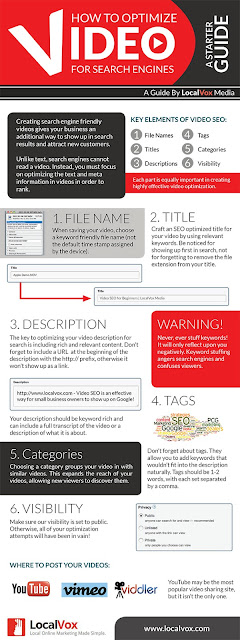
How to Optimize Videos for SEO - Infographic

How to Optimize Videos for SEO - Infographic


How to Optimize Videos for SEO
Video is an engaging way to publicize your company , products and services in a convenient to digest format for customers .It is so advantageous that 64% of website visitors usually tend to purchase a product online after watching a video.

In what way will you maximize your online videos so that they present in search engines like Google , Bing and Yahoo? LocalVox has collected a summary of six steps to optimizing your videos for SEO success in the infographic below.

Inform us : Are you currently using video SEO in your online marketing mix?

HOW TO OPTIMIZE VIDEOS FOR SEO


How To Optimize Videos for SEO infographic